
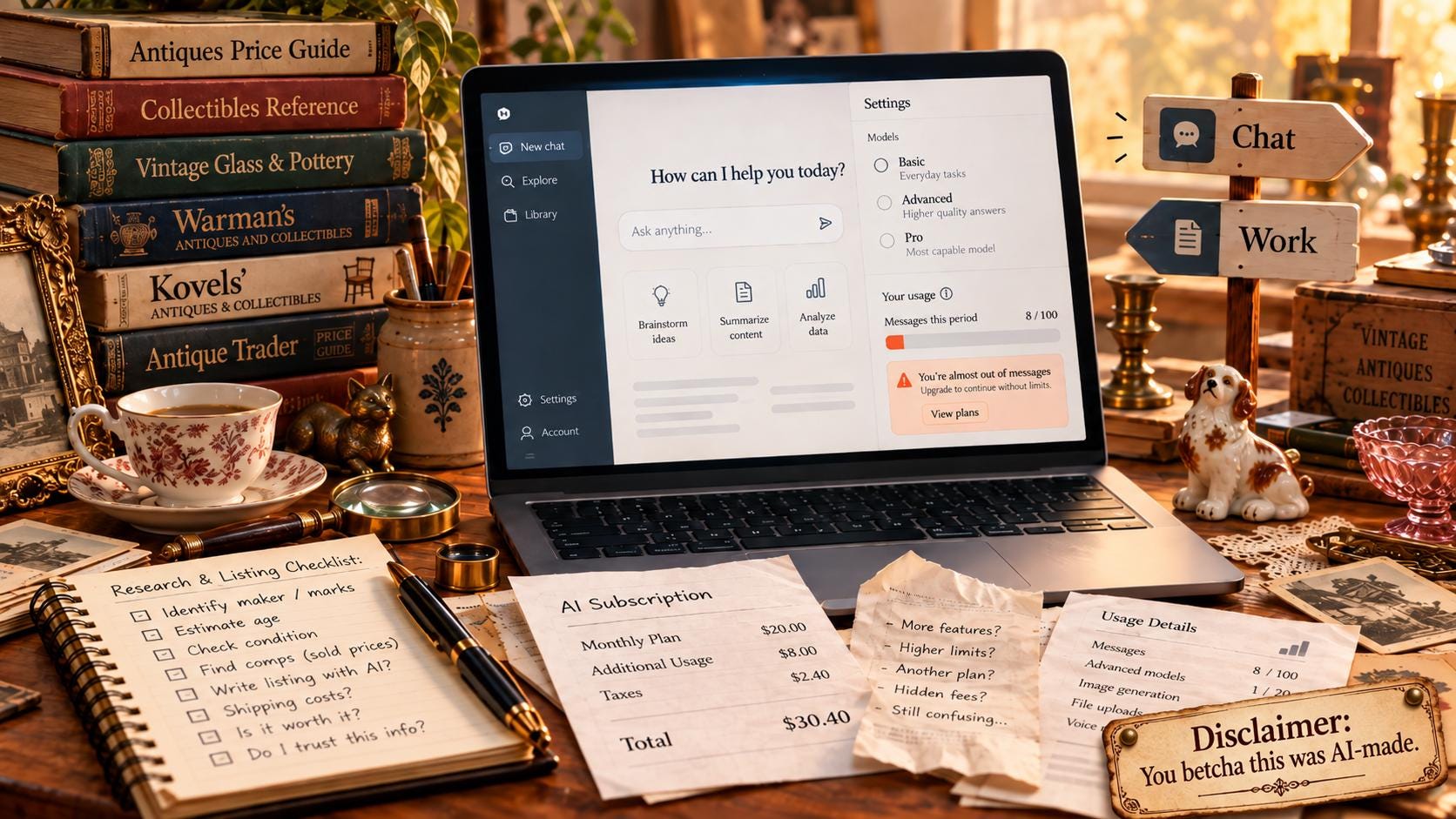
If you've shopped with Honeyblue Hollow, you know how this works. I research every piece within an inch of its life, tell you its story as honestly as history allows, and then rat out every chip, crack, and mysterious little scuff before you buy. I have personally outed more teacups than a tabloid.
Today's post is not about a teacup. I know. I'm disappointed too.
A lot of the research behind this shop happens with the help of AI. It helps me identify makers, chase down histories, and figure out what on earth I'm holding when the only clue is a stamp that looks like a sneeze. I love it. I'd like that on the record before we continue.
Over the past few months, though, the tools themselves became the mystery object. I paid for things I didn't mean to buy. My work vanished, reappeared, and refused to explain itself, like a cat. I spent more quality time with customer support than with my inventory, and my inventory has feelings.
So I did what I always do with something I don't understand: I researched it, documented the damage, and wrote up the condition report.
The result is an open letter to the companies building AI. It's long. It's honest. It's occasionally funny, mostly because the alternative was crying into a Pyrex bowl. And it asks for the same thing I try to give you every time you shop here: tell people what they're buying, disclose the flaws, and make it easy to get help when something goes wrong.
You don't have to care about AI to care about this. If you've ever paid for a subscription you didn't fully understand, or explained the same problem to a support line for the fourth time, congratulations. You're qualified.
"Curated with intention" applies to more than vintage. Here's the letter.
Condition: well-loved, slightly scuffed, fully disclosed.
Ignorance Might Be Blissful, but Awareness Without Education Is Terrifying
An Open Letter to the People Building Artificial Intelligence
I love AI. I am also exhausted by it.
And I think the people building it need to understand why.
I own a small vintage and antiques business. I spend a considerable amount of time researching objects, identifying their histories, writing descriptions, and trying to make sense of things people stopped manufacturing before I was born.
ChatGPT has become a valuable resource for that work. I use it to research, proofread, organize my ideas, and have conversations that probably make absolutely no sense to anyone who isn't me.
I genuinely enjoy it.
So imagine my frustration when I sat down to work one day, opened ChatGPT, and found myself somewhere I hadn't intended to be.
At the top of my Business account, there are two options: Chat and Work.
I run a business. I was there to work. So when the account opened on Work, that seemed perfectly reasonable.
It wasn't. Work turned out to mean Codex, a tool designed for writing software.
I'm a vintage dealer. I needed to research antiques. I had absolutely no intention of writing software.
And yet, there I was. Every time.
Both of my Business workspaces open on Work by default. To get the ChatGPT I actually use, I have to remember to click Chat before I start. If I forget, conversations freeze, credits drain, and I start over. I forgot just the other morning. I started over.
In other words, getting the product I'm paying for depends on me building muscle memory.
That was the problem I originally contacted support about. I wasn't asking for a technical investigation. I wanted to know why my business account kept opening in the wrong room, and how to make it stop.
But to understand how I ended up with two Business workspaces in the first place, we have to go back a little further.
At the time, I had a personal ChatGPT subscription. I was comfortable with it, familiar with how it worked, and had no intention of establishing multiple Business workspaces.
Then, while trying to finish an important task, I ran out of usage.
I needed to continue working. Suddenly, I was looking at upgrade options that I didn't fully understand.
One option was substantially more expensive than what I'd been paying. Another offered a Business workspace.
I understood that I needed more access.
I did not understand the differences among the options nearly as well as I thought I did.
So I started signing up for what appeared to be the available solutions because I needed to finish what I was doing.
And then something happened that frightened me considerably.
My information disappeared.
Conversations, projects, and work I had accumulated were suddenly no longer where I expected to find them.
I panicked.
I had been trying to solve a usage problem. Now I was wondering whether I'd lost work that mattered to me.
Eventually, my information began reappearing. The support chatbot had assured me that it would return, and it did, but not all at once.
That assurance didn't make the experience any less frightening. I could no longer find my work, and I didn't understand what had happened to it or when I would be able to access everything again.
Nobody had prepared me for that before I upgraded.
As things gradually settled, I discovered that I'd somehow ended up with two separate Business workspaces.
At first, I hadn't even understood that both were Business workspaces. I thought one was associated with my business and the other was essentially my familiar personal ChatGPT.
It took time to understand the distinction.
And by then, I had two Business workspaces, each with a two-seat requirement, even though I am the only person using them.
One person. Two workspaces. Four seats.
And a monthly bill exceeding $100.
What I originally wanted was simple: a workspace for my business and my familiar ChatGPT experience for everything else.
At one point, I explicitly told OpenAI that I wanted to keep both workspaces.
On paper, that looks like a decision.
In reality, I felt trapped.
By then, those workspaces held a great deal of my work: conversations, research, writing, and projects. Some were deeply personal. Others were directly connected to my business. They weren't things I could simply recreate if they disappeared.
And I'd already experienced the panic of seeing my information vanish once.
I requested exports from both workspaces.
From my business workspace, I received more than 5,500 files ending in ".json."
I had no idea what to do with them.
From my personal workspace, I'm honestly still not sure. I don't know whether that export ever arrived, or whether it was folded into the other one. At some point, I stopped asking.
I understood that my information was supposed to be in there somewhere, but I didn't know how to turn those files back into conversations I could read, organize, or use. More importantly, I didn't know how to ensure that I wouldn't lose something important if a workspace disappeared.
And given what had already happened during the upgrade, I was afraid to make another change.
What if I asked someone to cancel one workspace and they canceled the wrong one?
What if they canceled both?
What would happen to the projects I'd spent so long developing?
So I told support not to cancel anything.
Not because I wanted two Business workspaces.
Because I was afraid of losing what was inside them.
I did the math that I suspect a lot of consumers quietly do. Closing a workspace meant risking work I couldn't figure out how to retrieve. Keeping it meant continuing to pay for something I didn't actually want.
I'm still paying.
And somewhere in this process, I realized that three things had become hopelessly tangled:
What I purchased, what I wanted, and what I felt safe enough to change.
I assumed customer support could help me untangle them.
That assumption turned into an education of its own.
* * *
Over the following days, I corresponded with multiple OpenAI support representatives.
There were screenshots, timestamps, repeated requests for information, assurances about internal review, and a growing collection of case numbers.
I was told that my concerns would move through an internal review process. Later, I learned that a separate technical investigation hadn't actually been initiated.
I was asked for information I'd already supplied.
I was told some cases were duplicates.
I continued documenting the problems because I wanted someone to understand what was happening.
Eventually, a representative apologized for the repeated requests for information.
Then, in the very next paragraph, asked me to explain the problem again.
I wish I were exaggerating.
I am not.
By this point, I had accumulated enough correspondence to begin constructing timelines, comparing statements, and identifying recurring inconsistencies.
I also had a rather unfortunate new hobby: documenting the failures of the software I was paying to use.
And here's where the situation becomes particularly absurd.
I used ChatGPT to help me analyze OpenAI's own customer support correspondence.
The AI could retrieve emails, organize dates, compare responses, and help identify contradictions across multiple conversations.
Meanwhile, I was still trying to get a clear explanation from the company about why its product was behaving the way it was.
If the technology can help a consumer untangle that much confusion, why can't the institution providing it?
At one point, I was so exhausted by the process that I actually fell asleep while writing another response to customer support.
Not figuratively.
I fell asleep.
There is probably a metaphor in there somewhere, but frankly, I was too tired to look for it.
* * *
I'm 52 years old. My professional background includes approximately three decades in behavioral health, social services, healthcare administration, education, and organizational leadership. I have graduate education, doctoral-level research training, and substantial experience with research methodology.
I'm also a gamer. I spend an enormous amount of time on computers.
I am not someone unfamiliar with technology.
But I am not a computer scientist.
And despite my education and experience, I have found myself confused, overwhelmed, and at times intimidated by the systems through which AI is sold, delivered, and supported.
At times, I've even felt manipulated.
That doesn't mean I believe someone deliberately set out to deceive me. I'm describing what the experience felt like: making decisions within systems I didn't fully understand, struggling to get answers afterward, and increasingly feeling that changing anything might make the situation worse.
It made me wonder about someone else.
Let's call her Betty Sue.
Betty Sue has three children. Her husband works construction. Perhaps she works outside the home, too. Perhaps she didn't attend college.
None of that tells us anything about her intelligence.
She may possess knowledge and abilities in areas I know absolutely nothing about.
But let's imagine she has no formal training in computer science or AI.
She hears about ChatGPT and decides it might help her prepare a résumé, organize her family's schedule, or explore an idea for a small business.
So she opens a browser and searches for ChatGPT.
What happens when she encounters several services offering access to AI?
Does she understand which company actually develops ChatGPT?
Does she know what a GPT is?
Does she understand the difference between a model, an application, a workspace, a seat, or a subscription?
And more importantly, why should understanding those distinctions be a prerequisite for purchasing a product she simply wants to use?
I ask because something remarkably similar happened to me.
In 2025, I subscribed to a third-party AI platform called UseAI. At the time, I didn't even fully understand who OpenAI was.
I knew ChatGPT.
I knew what it did.
I knew I wanted to use it.
But I didn't understand that I'd subscribed to a separate company offering access to AI services.
Months later, I realized I'd paid more than $200 for an account I'd barely used.
I contacted the company, explained the confusion, and requested a refund.
A representative responded.
She confirmed that the subscription had been canceled and that the company had processed refunds for my payments.
I thanked her.
And I moved on.
No prolonged confrontation. No elaborate investigation. No collection of contradictory case numbers.
I didn't need to become an expert in AI platforms.
I needed someone to explain what I'd purchased and resolve the problem.
Why did I have to become a dissatisfied customer before I could become an informed one?
* * *
For much of my professional life, I have worked in healthcare and behavioral health, where informed consent is more than handing someone a document and assuming they understand it.
We learned a long time ago that giving someone information doesn't necessarily mean they've understood it.
One practical approach is called teach-back. Rather than simply asking whether someone understands, a provider invites the person to explain the information in their own words.
The purpose isn't to test the patient's intelligence.
It's to evaluate whether the information has been communicated effectively.
Imagine applying that principle to an AI subscription.
A consumer reaches a usage limit while trying to finish something important.
A new plan appears.
Before they purchase it, the company explains, in ordinary language, what changes, what it costs, what limitations remain, and what happens to their existing account.
Afterward, they receive a simple summary of what they bought.
If confusion develops, customer support can review the account history and help explain what happened.
And if the customer wants to leave, the company provides a way to retrieve their work in a form they can actually understand and use.
None of that requires making the technology less sophisticated.
It requires making the experience more understandable.
Disclosure is not the same as comprehension.
And providing access to information isn't necessarily the same as making that information accessible.
I learned that distinction rather vividly when I opened a data export and discovered what appeared to be an entire filing cabinet translated into a language intended for computers.
I wasn't leisurely comparing subscription options because I wanted to study the AI marketplace.
I was trying to finish my work.
The product had stopped me.
And the quickest apparent way to keep going was to spend more money.
Later, when I wanted to simplify the arrangement, I felt unable to do so without risking the very work I'd been trying to protect.
Getting into the system was easy. Understanding what I'd purchased was harder. And getting out felt harder still.
* * *
There's another familiar consumer experience this reminds me of: cell phones. Remember when we counted minutes and text messages? We knew a plan came with limits, even if we didn't always like them. Then unlimited talk and text became commonplace, and monthly subscriptions trained us to expect predictable access.
AI subscriptions can feel like those unlimited plans, except a meter may still be running. I spent a long time selecting newer models and higher reasoning settings because I thought I was choosing the best answer. I didn't understand how those choices could affect how soon I'd reach a usage limit. I found out when I couldn't continue working.
We've encountered this problem before. In 2010, an FCC survey found that 84 percent of wireless customers who had experienced surprise charges said their carrier had not warned them before they exceeded their allowance. In October 2011, the FCC, the wireless industry, and Consumers Union announced free automatic alerts for customers approaching voice, text, or data limits. The participating carriers served about 97 percent of U.S. wireless customers.
The carriers didn't have to eliminate usage limits. They had to help people see them coming. So why shouldn't AI companies do something similar: explain how settings affect allowances, show consumers where they stand, and warn them before access runs out?
The cost of a setting should be visible when we choose it, not when it stops us.
* * *
I've been thinking about a phrase:
Ignorance might be blissful, but awareness without education is terrifying.
Americans are becoming increasingly aware of AI.
They hear about it in the news. They encounter it at work. Their children use it in school. They watch thirty-minute documentaries on Netflix that may leave them wondering whether humanity has already made an irreversible mistake.
Then they open their phones, see another AI advertisement, and discover that apparently the future also comes with three subscription tiers, a usage allowance, and something called a workspace.
We are introducing sophisticated technology into people's everyday lives.
But awareness is not education.
And I have a hypothesis.
I suspect that some of the public's anxiety about AI is intensified by the experience of encountering powerful technology without being given the information, support, or practical understanding necessary to navigate it confidently.
Some people have legitimate concerns about employment, privacy, misinformation, and the broader consequences of AI.
Those concerns deserve serious attention.
But I wonder how many people are also intimidated by the more immediate experience of using the technology itself.
How many have made purchases they didn't fully understand?
How many have encountered problems and blamed themselves?
How many have become so frustrated with the surrounding systems that they've stopped using technology that might genuinely improve their lives?
And how many continue paying for something they don't want because they can't figure out how to leave without losing something they value?
I cannot answer those questions today.
But I think the industry should want to.
Because there's a difference between making AI available to everyone and making it understandable to everyone.
And I believe customer support is one of the most overlooked opportunities to close that gap.
For many people, contacting customer support is the moment they stop reading about AI and begin interacting with the institution behind it.
It's where confusion becomes understanding, or where trust quietly leaks out.
Yet the experience can instead become a series of troubleshooting instructions, repeated requests for information, and explanations that assume the consumer understands the very systems they are asking about.
Customer support is part of public AI education, whether the industry recognizes that responsibility or not.
And the consequences of getting it wrong may extend well beyond one dissatisfied customer.
* * *
I have spent a considerable amount of time documenting my experiences.
I have emails, screenshots, timelines, and records. What I've described here is only a portion of what I've been able to assemble in a relatively short period.
But I'm not writing this to bury someone beneath documentation.
My experience happened with OpenAI because that's where I spend my time. I'd be surprised if it's the only company that needs to hear this.
I'm writing because the documentation led me to a question I can't ignore.
If I have found this process exhausting, what happens to someone who doesn't have the time, experience, or resources to keep pursuing an answer?
I don't believe confusion should be treated as a personal failure.
I believe it should be treated as information.
When consumers struggle to understand a product, that tells us something about the product experience.
When support representatives repeatedly ask for information customers have already supplied, that tells us something about the support process.
And when a company develops technology sophisticated enough to analyze its own correspondence but cannot consistently provide clear answers to the people using it, that deserves examination.
Technology companies aren't villains simply because their systems have problems. Mistakes happen. But when those problems keep recurring, the consumer cannot continue being the person responsible for untangling them.
There are practical places to begin.
• Explain subscription options in language consumers actually use, particularly when they're being asked to upgrade at the moment they've hit a usage limit.
• Show customers how model and reasoning choices affect their usage, and give them clear, timely warnings before they reach their limits.
• Label features in your customers' language. In a Business account, "Work" should not quietly mean "software development." And don't make the specialized, credit-hungry mode the default that people have to remember to escape.
• Show people what they've purchased and what will change.
• Make account management and cancellation straightforward.
• Give people their data back in a form they can actually read and use, rather than expecting them to become amateur software developers just to recover their own work.
• Ensure customer support can review existing correspondence before requesting the same information again.
• Give consumers a coherent path toward resolution rather than sending them through an expanding collection of cases and conversations.
And perhaps most importantly, treat confusion as data about the consumer experience, not evidence of a deficient consumer.
* * *
I want AI to succeed.
This technology has helped me accomplish things I genuinely value. It has expanded the ways I research, write, learn, and solve problems.
I have no desire to abandon it.
But I am an ordinary consumer who has become exhausted by the extraordinary amount of work required to remain an informed one.
I have the education and experience to keep asking questions.
Not everyone does.
And I cannot help wondering whether the people most likely to give up are also among those who might have benefited from AI the most.
To the developers, researchers, executives, designers, and customer experience professionals building these systems:
I hope you'll consider what happens after someone decides to trust your technology enough to use it.
Not just whether the model works.
Whether the person understands what they've purchased.
Whether they can retrieve their own information in a meaningful form.
Whether they know where to turn when something goes wrong.
Whether someone helps them understand what happened.
And whether they feel safe enough to make changes to their own accounts without fearing that something important will disappear.
Because I suspect the future of AI will depend on more than how intelligent the technology becomes.
It will also depend on how intelligently we introduce it to the people expected to live with it.
Including Betty Sue.
Including me.
I don't want people to fear AI. I want them to understand it.
And I want the companies building it to care whether they do.
Amy Moore
October 2026